Harbor Freight Drill Hacking Fun

Drill Cracked OpenA long time ago, I got a Harbor Freight drill driver that was on sale for less then twenty bucks. I knew not to expect too much from the drill, but I thought that a motor,motor-controller, gear box, battery, and battery charger was a pretty awesome bunch of stuff for that price. The drill didn’t see much use.  At one point I took it to work and fashioned a spiraling hypo disc for it from office  supplies.  So I guess it did help me with some technical discussions at work, but for years the drill sat idle. A few months ago, my son wanted me to build a Van De Graaff generator. I was originally going to go with an AC motor, but my boxes of motors had very few fast AC motors. Lots of stepper/servo motors, lots of DC motors, and AC motors with gear heads, but basically no high speed AC motors. I read an Instructable about Van De Graaff generators that said you should be careful not to have sensitive electronics plugged into the same line as the generator! I don’t really know if that’s true. But if I went cordless, Pioneer might be able to take the generator to school, and we wouldn’t have to worry about randomly killing electronics around the house. I remembered that old drill, fished it out, and charged up the battery.  Much to my surprise, it was still functional.
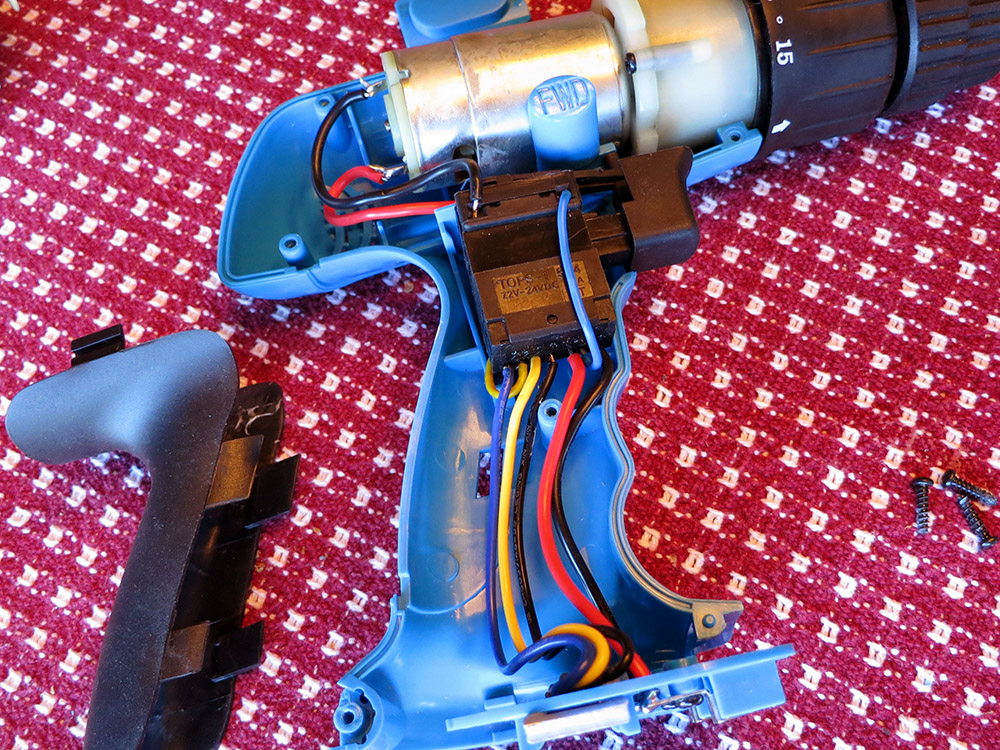
motorTriggerAndMosfetI knew I’d have to ditch the gear head in order to get more speed, so I ripped the thing apart. I took off the gear head, and the motor seemed to still have plenty of power, which was encouraging. I opened up the trigger assembly to see what was going on inside. I popped the case open, and  every wire immediately fell out. I happened to be holding the wires in order, so I groped around one-handed to get out my camera to document the wire order. Thankfully, I later found that I’d already taken enough photos to document the wiring, but it was an exciting moment. The controller uses a cleaver set of pinch connectors that release the wires as soon as the case opens. Fortunately, the trigger assembly actually has decent labels for all the connections.

Motor Control Cracked OpenI didn’t dissect the circuit that extensively, but there’s a very nice IRFZ44N N channel VMOS transistor that does all the switching, and it even has it’s own internal protection diodes, which means the circuit is really simple. The trigger switch is actually quite complex and cool. It does different tasks depending on its position. When the trigger is fully out, the switch shorts out the motor for quick stopping. When the trigger is pulled in all the way, the switch bypasses the  power transistor so it’s not doing any work. When the switch is in the middle range, the trigger is controlling the wiper for a linear potentiometer that’s controlling the speed of the motor. There’s a little 8-pin chip that is taking that pot’s voltage and producing a pulse-width modulated signal that’s driving the gate of the power transistor.
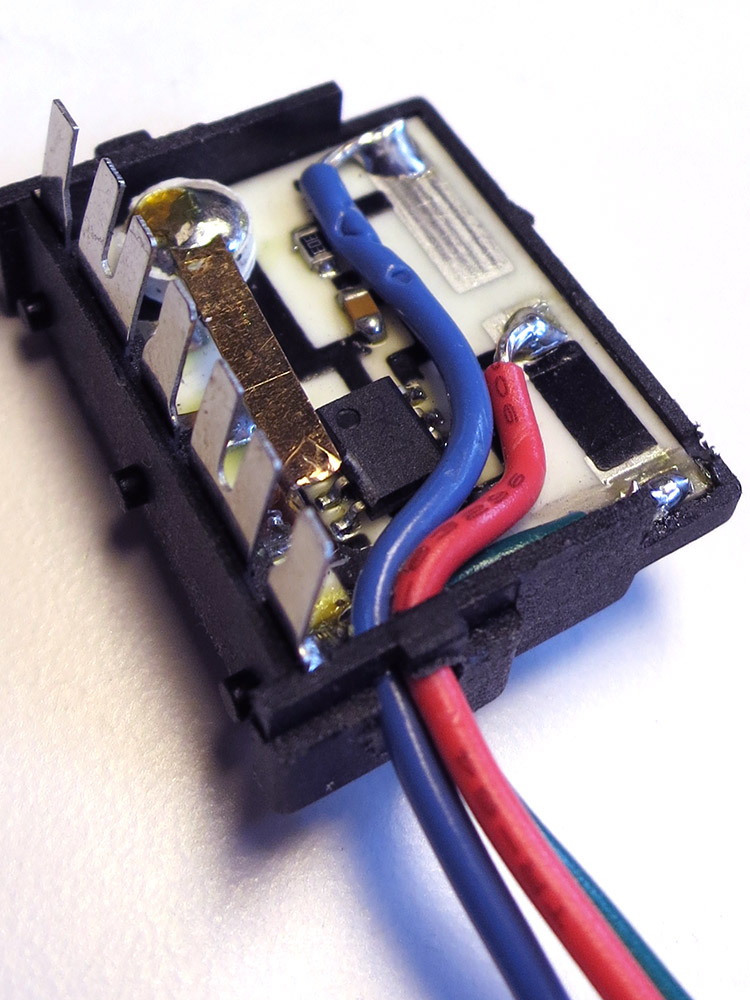
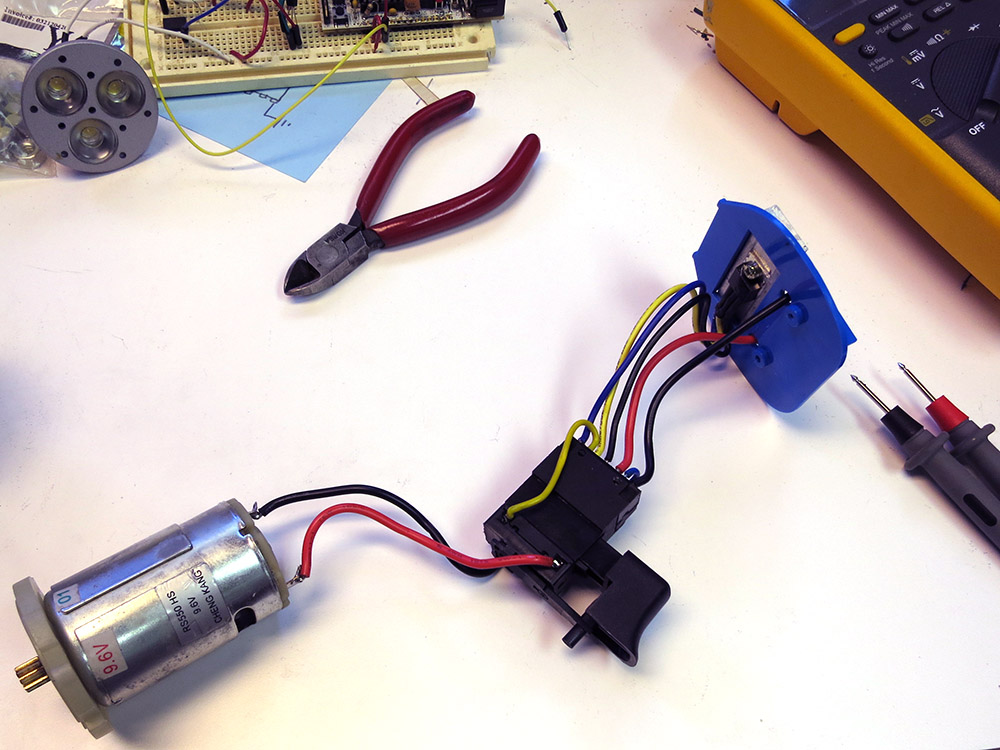
Motor Control RewiredIn an old Bosch drill that I fixed, the PWM was being provided by an actual 555. This little 8-pin chip was not labeled, but I kind of doubt a  555 can drive the kind of gate capacitance that Mosfet has. So who knows, but it doesn’t matter for this project. I thought, “Oh, I can force the switch into that middle range, then wire up an external pot for a nice knob-speed control” I cut the on-board potentiometer with a Dremel cutting disc and soldered leads to the three points of interest. Then I drilled a hole out the side for the wires to exit.  I also had to take my grinder and do incredible violence to the sliding-switch assembly that had been holding the wiper to make room for my big soldered wires. The switch was never going to work the way it used to.  I just had to hope it was going to work at all.

I started reassembling, and I realized that one of the tiny clips from that cleaver wire-clipping mechanism was missing! I spent 10 minutes hunting around on my cluttered work tables and grimy shop floor to no avail. I had just given up when (as I was walking out of the garage) I stepped and heard a funny scrape.  There, under my shoe, was the missing clip! *phew*

Pot Wired UpThe project was saved! Be careful not to lose those little guys. I re-assembled the trigger assembly without the trigger. The original internal pot was about 700k, so I plumbed in a 1Meg pot and decided to give it a try. It worked! At the low end, the motor would whine and not turn, but I knew I could wire in a fixed resistor so we could set the min PWM duty cycle that would make the motor and belt turn.  The knob would be the perfect speed control. Now the only problem was that I no longer had an on/off switch. I really wanted a switch integrated into the pot, but when I went to the surplus store all the pots with integrated switches where log-tapered pots.
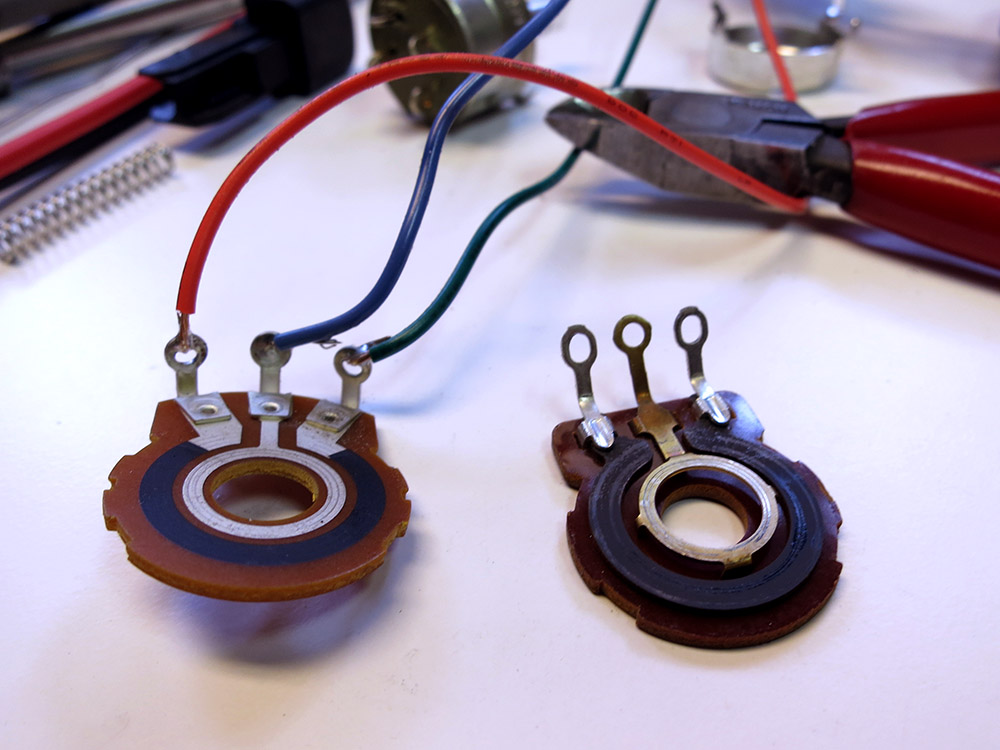
Two Pot Back PlatesI assume that’s because most people use an integrated switch when they want ‘off-on volume’ style controls and our perception of audio volume is logarithmic.  What to do? I didn’t  want to have to special order some pot just for this hack. So I decided to build a Franken-Pot (TM). I bought a pot with a switch, pried it open, and swapped resistive elements with a different 1meg linear pot. The surplus pot was clearly of much nicer construction then the cruddy RadioShack 1meg pot. The biggest difference was that the center contact ring on the surplus pot was raised up, but I bent its wiper blades out a bit more, and they were able to make contact with the other pot’s center ring just fine. I had to do a little bit of filing and grinding to make the bits fit snugly, but once I had the tabs bent back down, no one would be able to tell it wasn’t just a stock pot.

Donner Pot(Full disclosure: mostly, I just wanted to be able to say stock pot.)

So that was a bit of a side adventure. I wired in the fixed resistor to set the minimum PWM and wired in some connectors so the pot could be unclipped when you opened the base of the generator.  Then it HIT ME. The big mistake. I had one of those “What was I thinking?” moments. This thing was going in the base of a machine that was going to be shooting 100kv sparks around. That electronic speed control was never going to survive in there. I was going to have to go back to a simple on/off switch and this whole motor control adventure had been a kind-of-fun two afternoon waste of time! *smack forehead*

Oops. FAIL

Making Moomin Stacking Stools

I’m a big fan of Tove Janson and her lovingly illustrated kids’ books about the Moomins.  When a coworker sent me a link to a set of Moomin-themed stacking stools that had apparently never come to market, I thought “I bet I could make a set of stools like that in one night!”   I’d been working a bunch of long hours, and a goofy one-night project seemed like it would be a nice diversion.   Should I have taken on another project instead of finishing up the Van de Graaff generator?  I don’t pretend to be fully in control of which projects I work on when.  I looked online for some cheap stacking stools, and they were soon Amazon Priming their way to my house.   I crossed my fingers that the stools would have legs that could be removed so I could fit the seats in the laser cutter.  Thankfully, they did.

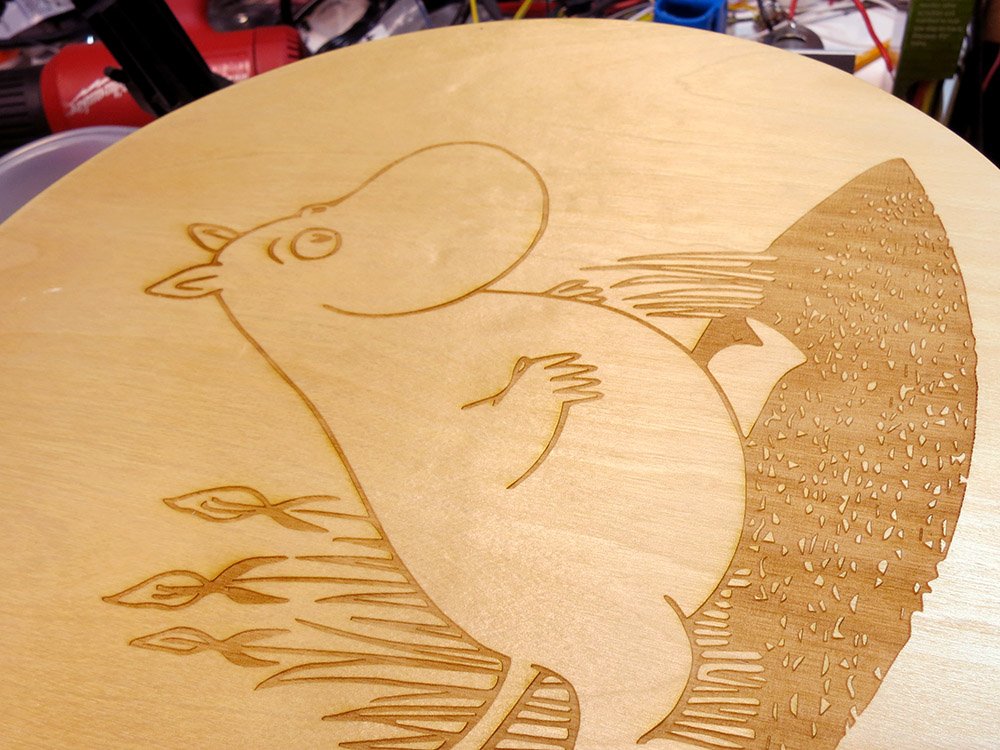
Cardboard CircleI laser cut a piece of cardboard to act as an alignment jig. Then I used the laser’s raster mode to etch the designs onto the seats.   The plan was to etch the design on, then use paint and a squeegee to make the designs stand out.  I’d used that trick before when making the seals for the Retrotechnologist society with good results.

Moomintroll Before PaintAfter etching Moomintroll, I began to wonder if painting would be necessary.  He looked good, and I’d even managed to orient the wood grain so it serendipitously lined up with some of the reeds in his little patch of water.   Maybe this project was going to be even simpler then I thought!

Little My From Two AnglesPaint And Squeegee

When I etched Little My, she looked good from some angles but terrible from others.  The orientation of the wood grain had somehow made her very viewpoint dependent.  Here’s a little video of the laser etching and her Cheshire Cat magic trick.  Clearly she was going to need the paint treatment.  I finished etching them and headed home to apply the paint.  When I did, I got a nasty surprise!

Moomintroll After PaintThe stools where cheaply made; the clear coat was uneven and had lots of tiny holes which the black paint was happy to highlight!  Would I be able to make them look okay with some scrubbing and sanding?   I hoped so.  I applied paint to all but the Moomintroll stool.  He was so lovely without paint that it felt really risky to slather him in black, but I didn’t want him looking different and getting all self conscious.  So I took the plunge and smeared on the black paint. Then I went in the house to scrub my blackened hands and go to bed.  All the while wondering if this project could be salvaged.  Had I been working on a  one-night disaster?

So much for only taking one night

Snufkin Paint FixesThe next morning, I tried various tricks to see what could save these stools.   I tried sanding with a flat block and 220-grit paper.  Finally it seemed like the best results  where achieved by just scrubbing like mad with a wet scrubby sponge.   Snufkin’s stool had the worst surface, but since his scene was at night, the splotches didn’t seem that out of place.  I had to apply some paint fixes after some over-zealous sanding.  I applied the paint in ways that added to the figures so any mismatch with the background would look intentional, like shadows and folds instead of random patches.  I used the red sable brush I saved up for when I was in high school.  It’s still my go-to brush, and it has seen a LOT of use.

Four Stool Tops On DeckThankfully Moomintroll’s clear coat seemed to be the best of the lot, so he didn’t have too many bad specks.  I was also able to take a more painterly approach to cleaning the beach scene stool.  I scrubbed the dune crests more so they’d be lighter and even left some of the dark surface paint in place on parts of the ocean.

I got them to a point where I was no longer embarrassed about the look, and then I brushed on a quick clear coat of Minwax polyurethane semigloss.  I use that finish on a lot of my projects, so I already had some on hand.  It’s tough and fairly forgiving.

Screw On LegsAfter they dried, I put the legs back on.   You can see the little felt patches that keep the stools from scratching each other when they’re all stacked up.    
A long time ago, I bought a giant pack of 160 self adhesive felt pads with foam tape on one side. They’ve come in very handy on a lot of projects.   They’re on the bottom of the Van de Graaff generator, and I knew I’d have to put some on the stool feet.


Felt Feet
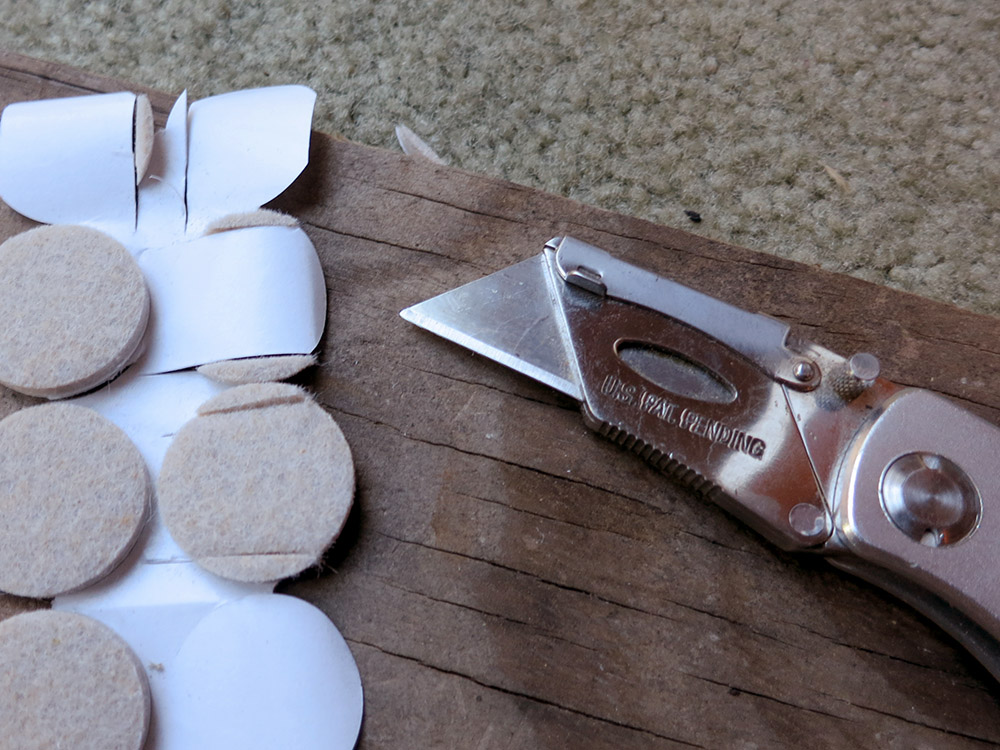
The pads were a bit too big for the stools, so I got out the razor knife and started trimming them to size.  Once those were on, it was time to try the stools  out!  First for slacking, and then for stacking.

I guess when all’s said and done, I wasn’t satisfied with the results of this project.  The black specks that no one else seems to notice really bother me.  The stools aren’t super comfortable, and we didn’t strictly need more seating around the house. I can’t declare it a resounding success, but it was quick, and they may come in handy.  Who knows.

Stool Test With PioneerStool Test SimonfinalStoolStack

Building a Van der Graaf Generator from Ikea Parts

My son Pioneer has been going to Rock-It Science camp.  He loves it SO much.  He calls it “make it and take it” because he gets to build a lot of things and bring them home.  When he heard they were going to have a Van der Graaf generator, he assumed they were going to be building them and bringing them home.  He was rather disappointed when he found out they were just going to watch one in action. I cheered him up by telling him we could build one ourselves.

Of course I don’t know why I’m building this thing. I do not like electrical shocks. When I was in college, I worked at The Mellon Institute of Battery Technology (MIBT), and I spent enough time troubleshooting weird electrical devices that I would sometimes get shocked. I realized I was using classical conditioning to make me not like my job.  If instead the devices had been handing out food pellets, things would have been a lot nicer.  Building a device that is pretty much guaranteed to dispense a fair number of electrical shocks seems on the face of it to be a bad idea.

Bowl About To Be CutWe did have some cool stainless steel bowls from Ikea that had been been whispering to me about how they wanted to be high voltage electrodes.  I decided to take a trip to Ikea specifically to shop for Van der Graaf Generator parts.  And thus the Van Dö Kraff project was born.  I was originally going to go for the 11″ bowls like we had at home, but when I got to Ikea I couldn’t help but notice the awesomeness of the giant 14″ bowls.   I also wanted to get some sort of base for the project and saw that they had a nice wooden lazy Susan that was just the right size to go with one of the bowls to make a base.  Plus who can say no to a Snudda!

I had a secret reason for wanting to get the lazy Susan.  In order to build the generator, I’d have to cut a hole in two of these great big bowls.  They were never going to fit in my lathe, and although I could cut the holes out by hand, it would be somewhat sloppy and imperfect.  I realized that if I had a lazy Susan I could use that as an improvised lathe.   This lathe -e- Susan worked super well. Here’s what we did:


Bowl With HoleCenter the bowl on the lazy Susan using fun tack.  I just spun the bowl and used my finger to find the closest point to the edge and then nudged the bowl over until it was running without a lot of wobble.   Then I mounted a cutting disc in the Dremel tool and brought it in contact with the bowl tangent to the circle I wanted to cut out. The spinning of the cutting disc caused the table to spin, making the disc cut a perfect circle.  My son helped me with this by using his finger as a drag to keep the bowl from spinning too fast.  He also helped once the disc had cut though in some areas by turning the bowl around manually to the parts that hadn’t cut though.  I used up 4 discs cutting the first hole and 3 more doing the second.  I think with a little practice you could get it down to maybe 2, but you have to be very careful when the disc first cuts all the way though.  It’s very easy to have the discs shatter then.

My son loved the exploding discs.  He thought that was the best part!

Once the hole is fully cut out, you can switch to a sanding drum to smooth out any sharp burs and presto!  Perfect holes!  I used two random boards and a clamp to make an improvised steadying rest for my Dremel tool.  Here’s a short video showing the cutting.  Remember to keep the discs level and tangent to the cut.

Test Fit of the Column in the BaseAs you can see, you can get a very close fit using this system.  I used a Sharpie to make lines and test with the piece of pipe until I was close, and then just double checked the size once I got a groove started.  Be careful to approach the line you want from the inside since you can make the hole bigger but not smaller.

pioneerAsElectrodeMan

Here’s ElectroMan declaring the very first stage of this silly project a success!

Making Medicine Count Down Board

Sick Simon Simon had a high fever for several days. We got him to take liquid Tylenol exactly twice: he took the cherry flavor once and the grape flavor once. After that, he declared they both tasted like toothpaste, and even though they helped him feel better, he was not interested. When we took him to the doctor, it turned out he had an ear infection, so Simon was prescribed a 10-day course of antibiotics to heal what was ailing him. Simon did not like to take the medicine.  He was groggy, feeling miserable, and having none of it.  For one dose, we  had to force him to take it.  It was a parenting fail.

When I was growing up, my parents would make count down boards so we could count the days until we went on a trip. They would have a row for each day and two columns of treats, one for me and one for my sister. It was a bit like an advent calendar, but it helped us watch the days until we drove off to Florida or some other destination.

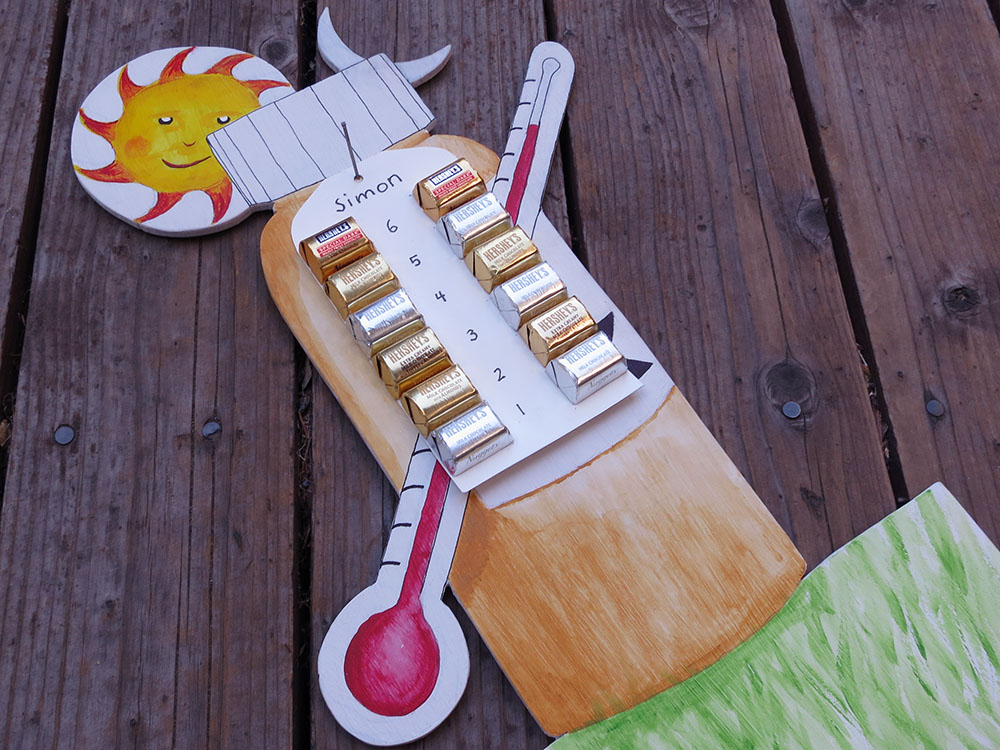
Gesso The BoardI thought maybe I could do a similar thing for Simon. He would have a treat after each dose of his meds, and it would visually represent the number of doses left so there would be an end in sight. I thought that might become pretty important as he started to feel better and was even less excited about swallowing a big pink spoonful of yuckiness.

In the interests of time, I didn’t design this thing to be laser cut. I needed one NOW! I sketched the design onto a piece of plywood and cut it out freehand on the bandsaw. Then I slathered the whole thing with Gesso, a kind of primer for doing acrylic painting. Normally I would have done a couple of coats and sanded it smooth, but I didn’t have time for that and I figured the rough Gesso brush strokes might add something to the look. The next morning it was dry and I sanded it lightly being careful not to sand through.

The Final BoardThen I got out my brushes, painted the design with acrylic artist’s paint, and did the outlining with a sharpie since my tube of black paint was AWOL. I used the black to paint the faces on my pastry cutters, so it’s probably still in that project’s box.

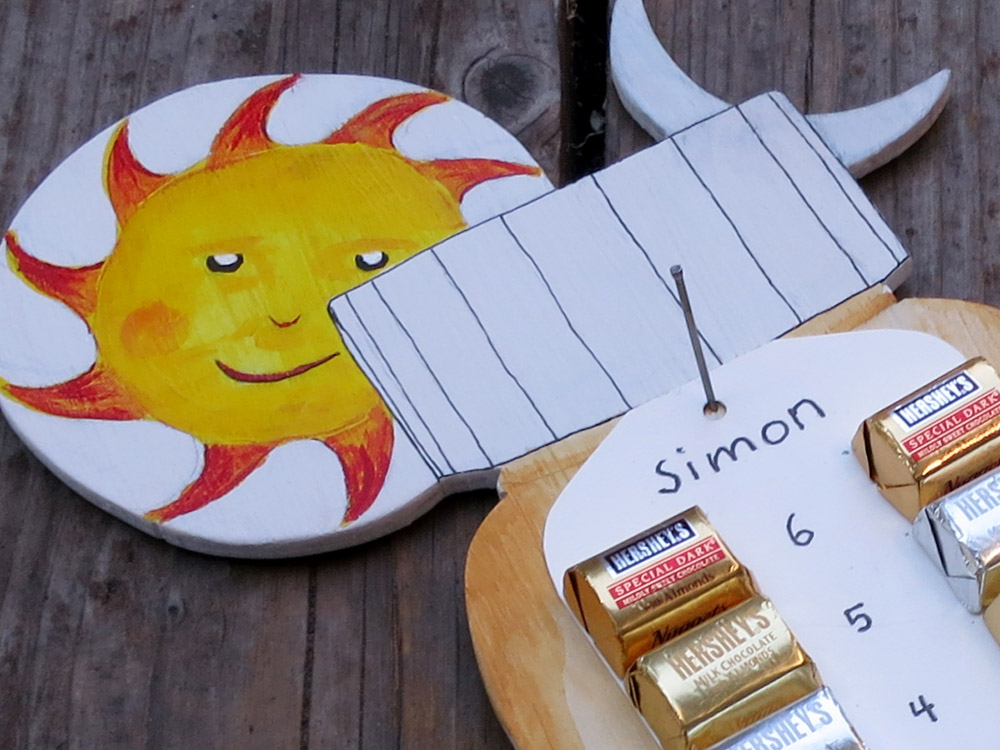
The design has a sun and a moon for the morning/evening dose columns. I have built some boards where I just hot-glued the treats right to the board, but  I decided instead to glue them to a card that would hang on the board. That way the next time one of the kids needs to take meds, I can just make a new card.

Board Close UpI had some trouble with the sun’s rays. I had them coming too far into the face area.  I had to let it dry and repaint that part a bit. Haste makes waste. Simon liked the board, and was good about taking the meds once he was “on the board”. It’s hard to tell how much of that was “Simon getting used to the medicine” versus “Simon is encouraged by the count down board.” I’m going to guess it was about 60/40.
I do think it really helped with the later doses since he always knew they were coming and how many there were left.

I’m glad we have the board. The next time one of the kids needs to take some medicine, it will be waiting to lend a hand.

chocolatesInPlace

Making Triumph Spitfire Parts

Spitfire Unloading Grandpa Stan bought this 1962 Triumph Spitfire and has been restoring it.  It had two brackets that hold the stabilizer bars, but his were horribly bent and broken.  I guess those brackets are hard to get because he asked me if I could make some replacements.

Problem PartHe gave me the the less destroyed of the two plates.  I was able to get some rough measurements.  I had sheet of metal with the same thickness, so the first thing I tried was cutting a piece out with the bandsaw and bending it into shape cold.

I used the vice and a big hammer to incrementally bend the center channel.  I clamped the metal in, hit it a few times, moved it up in the vice a little, and hit it some more to continue the bend.  Then I bent back either side of the channel to form the  transition from center curve to flat. Finally I bent up the two edge wings.  I had left plenty of extra metal for the wings to give me leverage.

This cold bending system was simple, but the results were poor.  The positioning was not super accurate.   The curved channel’s shape got distorted when I bent back on either side to make the transitions, which were not all that crisp.   I had to admit I wasn’t going to be able to bend it cold.

The reason I’d been trying to avoid working it hot was that the plates were just a little too wide to fit into my super tiny forge.  That meant that I’d need to haul out my foundry furnace and burn 45 minutes worth of propane just to get the furnace up to temp.  I guess I could have used to OA torch with a rosebud tip to do the heating, but then there would be one more thing to juggle around, and I don’t have five hands.

Some metal-working friends suggested forming the pesky center channel curve by placing a vice set to the correct width underneath the hot metal, having a heavy bar (with the correct radius) on top, and hammering down the bar to force the metal into shape.  I put my drill press vice on the anvil and set its jaws to the spacing I needed.  Some hunting though the scrap pile under the house turned up a solid bar that was close to the right radius.  I had a pipe that was the exact radius, but I thought that might not be able to take the hammering without going out-of-round.  It seemed better to use the solid bar.

Piece On the Vice Backed Up by an AnvilHere’s the plate on the vice, and you can see the metal bar in the background.  I put the vice on the anvil so it would be able to take some pounding.  The plan was to heat the plate in the furnace, fish it out with tongs, and position it on the vice.  My wife would then place the rod into position, and I’d hammer it down.  We practiced it cold, and then gave it a try.  We were a bit slow, so I ended up  having to do 2 heats to form the channel, and then another heat to fine tune the transition back to flat.

piece In The FurnaceWe banged channels into two of the plates, and it was time to put all this stuff away.  At least we put on an interesting show for the kiddos.  It was kind of  a big production for two little curves.

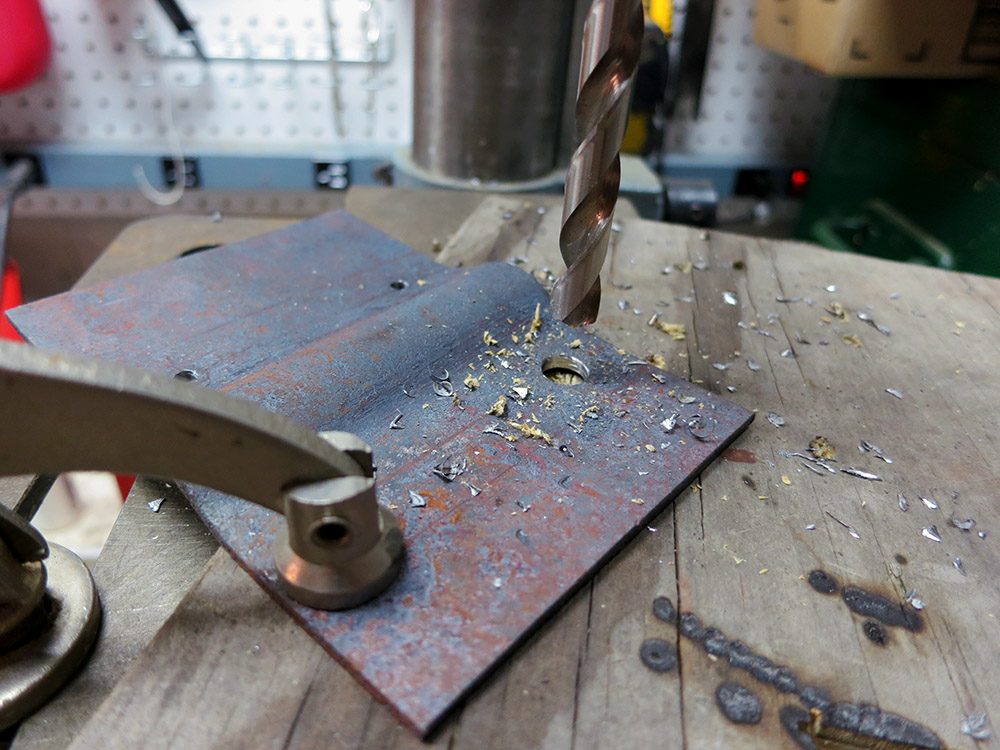
That was it for the hot work.   The next day I scribed, center punched, and drilled the holes on the drill press. Simon came out to help, so I let him stand on a stool and turn the drill press on for each hole.

Simon HelpingWe talked about drill press safety, like how it’s good to clamp the work down. We also discussed how to position the piece so if the bit catches, the part spins into something solid that is not the operator.  He did a good job helping.  I like his safety gear.

We have strict rules about “no bare feet in the shop,” but I guess Tigger feet are all right.  I love that those Harbor Freight face shields adjust down small enough for his head.

Drilling The HolesOnce we had all eight holes drilled, it was time to bend up the wings at the edges.   I just did that cold in the vice.  One tricky part was that in order to not squash the center channel area, I had to extend the jaws of the vice a bit with some square stock.

This part is where Simon helped a lot.  I was able to align the square stock and the part in the vice, and then tell Simon to crank the whole thing tight.  There was certain amount of “No the other way!” but it really was something that would have been a pain to do on my own.

partInViceLastBendlastBend

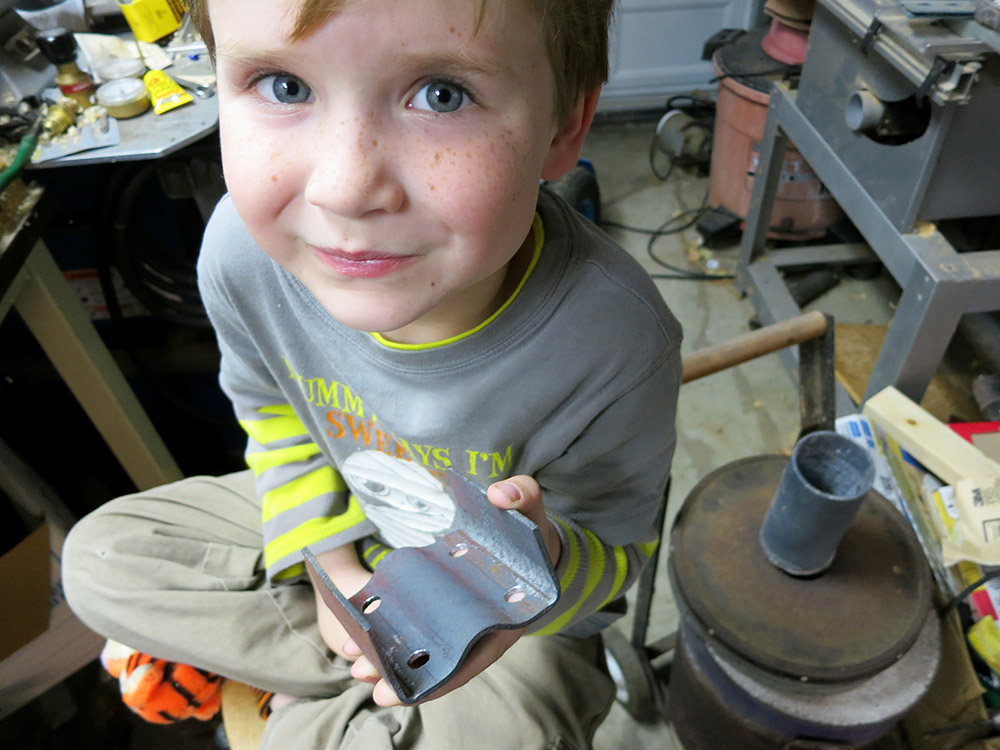
simonWithThePart

Then all I had to do was mark and hacksaw off the long extra parts of the wings.  The channel in the middle made it impossible to cut the excess off with the bandsaw. A nice sharp hacksaw can work wonders even if you do end up sweating a bit for the results.

finalParts

Here they are after being cut and cleaned up with a file. I think they came out fine. They’re hand made, so they’re not crazy precise.  Hopefully they’ll be good enough. It’s time to sand blast them, clean them up,  and mail them off to Grandpa.

Dyeing Flowers

During Teacher Appreciation week, we wanted to have some fun flowers for Pioneer to give out at school. He had a book that mentioned that you could make multicolored flowers by splitting their stems and putting the ends in dye. The dye gets sucked up to the head of the flower and, voilà, multicolored flowers.

Stem CuttingWe decided to give it a try. I got two dozen white carnations and put them to the sword.  Actually I used an Exacto knife to split the bottom two inches of stem. Pioneer worked away putting a loop of scotch tape around the stem above the split to keep the split from propagating. Then we cut down 4 plastic cups so the split stems could reach all the way down to the bottom of the cups.

Dyed Flowers HangingWe put different colored food dye and water into each of the 4 cups and used a loop of yarn to lash the flowers to a kitchen cabinet. Then I performed the somewhat ticklish task of getting all the flower stems to span the 4 cup boundaries. Once that was done, we just let them sit in the water over night.

In the morning, the flowers had taken on some of the colors. The colors weren’t super dramatic. I guess if you started with shorter stems or let them sit longer, you might get more color. I thought they came out looking good. Since I had left the stems quite long, we were able to just hack off the stems above the tape and presto! Colored flowers.

Blue And White FlowerI was really worried about the dye getting all over the counter. I put a plastic bag under the cups, and I’m really glad I did. In the morning, quite a bit of dye had found its way out of the cups and onto the plastic. I had to very carefully lift the bag up by the corners and carry it to the sink. Thankfully the plastic bag didn’t have any holes in it. If I do this again, I will put all the cups in the bottom of a glass casserole dish so I won’t have to play Food Dye Bomb Technician during clean up.

PioneerWithFlowers